Reading time :
6 minutes
Table of Contents:
Keywords: UXDesign, Psychology, CRO...
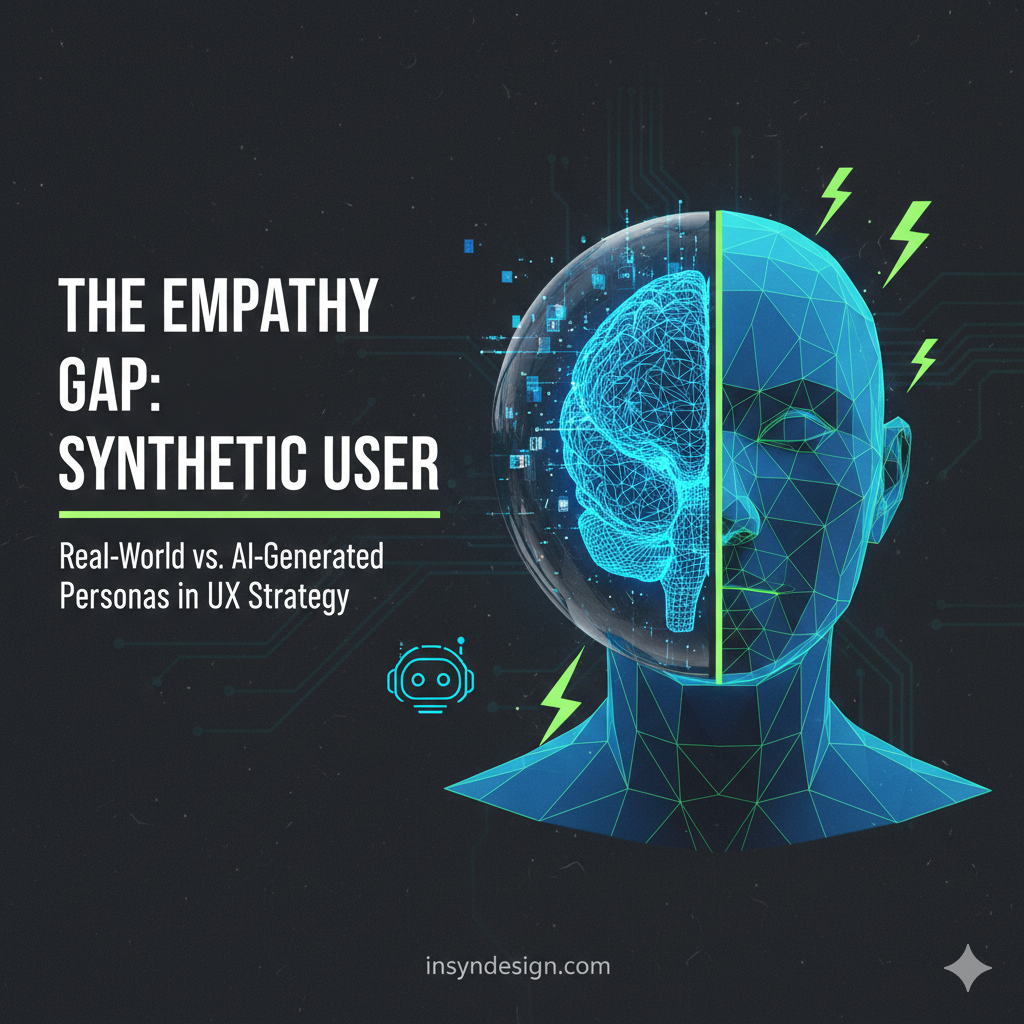
In the fast-paced world of digital product design, speed to market is everything. Over the last year, a dangerous but tempting shortcut has emerged in UI/UX strategy: using Large Language Models (LLMs) to instantly generate user personas. Instead of spending weeks conducting interviews, surveys, and usability tests, product managers can now type a prompt and receive a perfectly formatted, highly detailed persona in three seconds. "Meet Sarah, a 34-year-old marketing manager who struggles with time management."
It looks incredibly convincing. But beneath the surface of these AI-generated users lies a critical flaw that is costing companies millions in misguided product development. At Insyn Design, we rely heavily on both AI efficiency and deep Human-Computer Interaction (HCI) principles. Here is our comparative breakdown of synthetic versus real-world personas, and how to use them safely.
There is no denying the initial utility of AI in the UX research phase. When launching a new product, you need a starting point. AI excels at pattern recognition, synthesizing billions of data points across the internet to give you the mathematical average of your target demographic.
It looks incredibly convincing. But beneath the surface of these AI-generated users lies a critical flaw that is costing companies millions in misguided product development.
AI algorithms are patterns of probability, not empathy. When you ask an AI to simulate a user's frustration, it isn't "feeling" that frustration; it is predicting what a frustrated person would likely say based on its training data.
Even the most advanced LLMs can't simulate the visceral, irrational human emotions that occur when someone is stuck in a stressful checkout flow or trying to navigate a complex medical portal.
At Insyn Design, we suggest a tiered approach. Use AI for the initial mapping and broad strokes, then validate with real human participants.
A recent client used AI to design a retirement app for elderly users. The AI persona was perfectly logical, but it failed to predict that users in that demographic have a physiological distrust of digital-only buttons that lack tactile feedback.
Another client found that while AI predicted a linear journey, real users were actually oscillating between the cart and shipping details due to anxiety about delivery dates—something the synthetic user never "felt."
As we move forward, the most successful designs will be those that use AI as a tool for efficiency while relying on human researchers for empathy. Empathy is the one thing you can't calculate.
UX Audit
Uncover what your users really need with our deep-dive UX Audit.
Author
picture
Name:
Insyn Team
Bio:
Creative strategists and designers passionate about great digital experiences.
We help businesses grow smarter with innovative digital solutions, strategic design, and cutting-edge technology — everything you need to level up and lead your industry.